On the afternoon of April 23, the Third Yangtze River Delta Fiscal and Taxation Forum included both a round table forum and topic discussion.
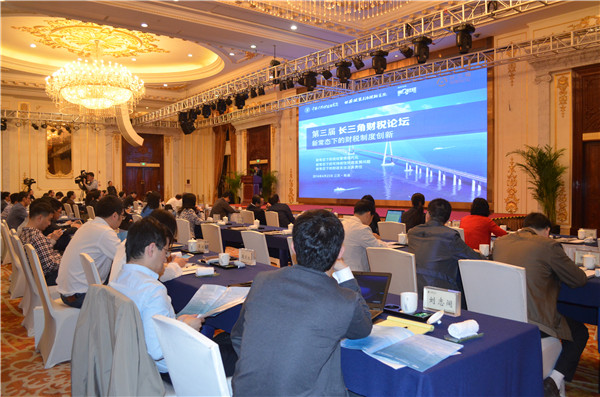
One of the three issues discussed included the Modernization of Tax Administration under the New Normal. There are several problems in our current tax administration such as inaccurate tax base, and nonstandard collection, which form obstacles to our economy and society. Under the New Normal, making use of IT methods to reach increase the accuracy of tax collection, and making tax actions governed by law, will be the goal for tax authorities. The round table forum was presided by SUFE President Fan Liming.
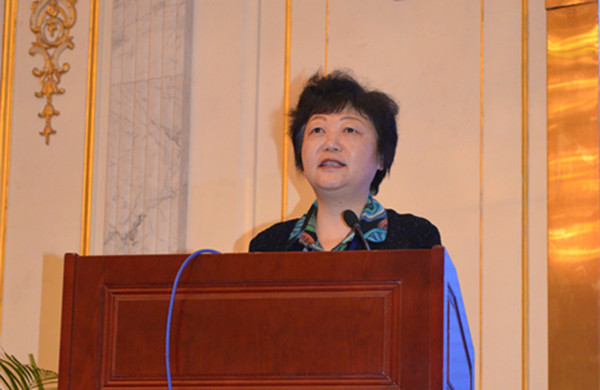
Deputy Director of the Shanghai Tax Bureau Hu Lanfang, former Deputy Director of Zhejiang Provincial People's Congress of Financial and Economic Affairs Committee Zhou Guangren, Deputy Director of Hubei Provincial Local Tax Bureau Yang Xuchun, and Associate Professor Wang Chong of the SUFE School of Public Economics and Administration (SPEA) all joined in on the discussion.
Zhou Guangren shared his understanding on the difference between management and administration on subjects, methods, and paths. Then, he demonstrated shortcuts to tax administration modernization; believing that a major solution is to share information between tax departments and other departments.
Hu Lanfang mainly talked about how to find loopholes in tax collection through Internet+ and Big Data; which would extend to all corporations.
Yang Xuchun used Nanzhang county as a case study and introduced Hubei's progression on sharing and cooperating between the State Administration, Taxation, and Local Tax Bureau departments. Later he offered his point of view on it's future development.
Wang Chong shared on non-tax income collection and how to improve tax compliance.
In the topic discussion session that followed, Director of Taxation Bureau of Suzhou Industrial Park Ma Wei introduced their research on the Tax Administration Modernization Index System. By studying the experiences of the US, Singapore, and the International Monetary Fund, and by summarizing the practices of our nation, Ma Wei established an index system on Tax Administration Modernization which has been applied to the Suzhou Industrial Park Local Taxation Bureau and will be introduced to other cities. Then, Dr. Zhang Muyang of the SUFE China Public Finance Institute (CPFI), talked about Value Added Tax (VAD) collection issue after the VAT reform and then proposed to simplify the VAT rate. At last, professor Nie Haifeng of Ling Nan (University) College, Sun Yat-sen University, shared his analysis on the impact of VAT reform on tax income.
The second issue discussed was the Sustainable Public Finance Rule of Law Problems under the New Normal. After more than 20 years of high-speed development, our nation is facing a decline in the economic growth rate, an aging population, and a decline in corporate profitability. Under such a situation, public finance is facing an immense amount of pressure. This round table forum was presided over by the Executive Dean of the Anhui University School of Economics, Li Guanglong.
Director of Wuhan SAT Income Planning Department Director Yan Shaoping, Deputy Director of Scientific Research Department at the China Academy of Social Science Finance and Economics Strategy Institute Yu Shuyi, and Vice Dean of the SUFE China Public Finance Institute Fan Ziying, joined the discussion.
Yan Shaoping mainly introduced the current situation of Wuhan public finance and policy. Then, Yu Shuyi analyzed sustainable reform, while Professor Fan recalled historical examples and possible policies for current problems.
The discussion continued with Prof. Deng Xiaolan of Xi'an Jiaotong University, Gao Wei of the Finance Bureau of Jiangbei Disctrict in Ningbo, Li Shunming of the Guangxi College of Finance and Economics, and Liu Zhikuo along with Fan Ziying from SUFE.
The Third topic was: Public Finance Expenditure and Duties under the New Normal. Common ground regarding public finance expenditure between central and local government was very hard to come by, and led to a fierce discussion. This topic was overseen by Deputy Dean of the SUFE School of Public Economics and Administration, Liu Xiaobin.
Director of the Zhejiang Provincial Finance Department Budgeting Bureau Zhang Qicheng, introduced their dividend principle: to not provide to companies and to not provide to cities and counties. He also introduced their distribution of transfer payment funds. Dean of the Hubei University of Economics Public Finance and Administration School Cai Hongying, agreed that we should make it more clear how to identify central and local responsibilities. Deputy Director of the Finance and Trade Economics Editorial Department Zhang Deyong, thought we should classify duties by rights, but that there is no good way to do this in practice. Deputy Dean of SUFE SPEA Fu Wenlin said we would never confirm the duties before we confirm the income, the rights, and transfer payments. At the end, Prof. Liu Xiaobin gave a brief summary of the discussion.
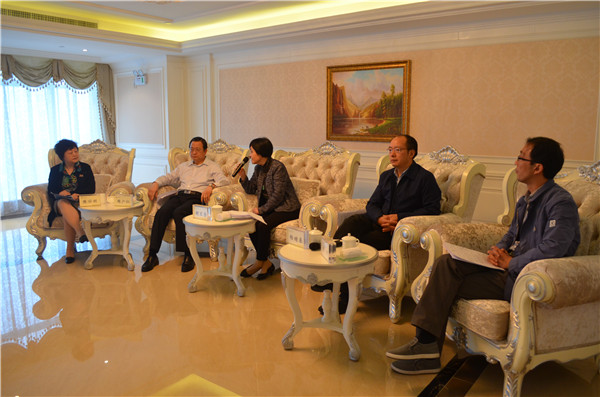
Afterwards Deputy Dean of SUFE CPFI Yu Hong and six experts held a further discussion. Lü Kaibo from the Zhejiang Gongshang University School of Finance, spoke about public finance expenditure duties related to theory and practice. Gao Lin of SUFE SPEA also recalled public finance expenditure duty theory and proposed his own viewpoints. Zhou Lizhu from the Zhejiang Finance Department Policy Research Office presented a summary of public finance expenditure situation. Cu Shuyi of the China Academy of Social Science Finance and Economics Strategy Institute introduced the four 2015 governmental public finance budget plans and talked about their existing problems. Shen Cai of the Changzhou Finance Bureau went over law issues and proposed three reform measures. Zeng Yi from the Zhongnan University of Economics and Law Public Administration School, talked about endowment insurance under the comprehensive two children policy. Finally, Yu Hong summarized the discussion and the forum came to a happy ending.
